
History
that abounds
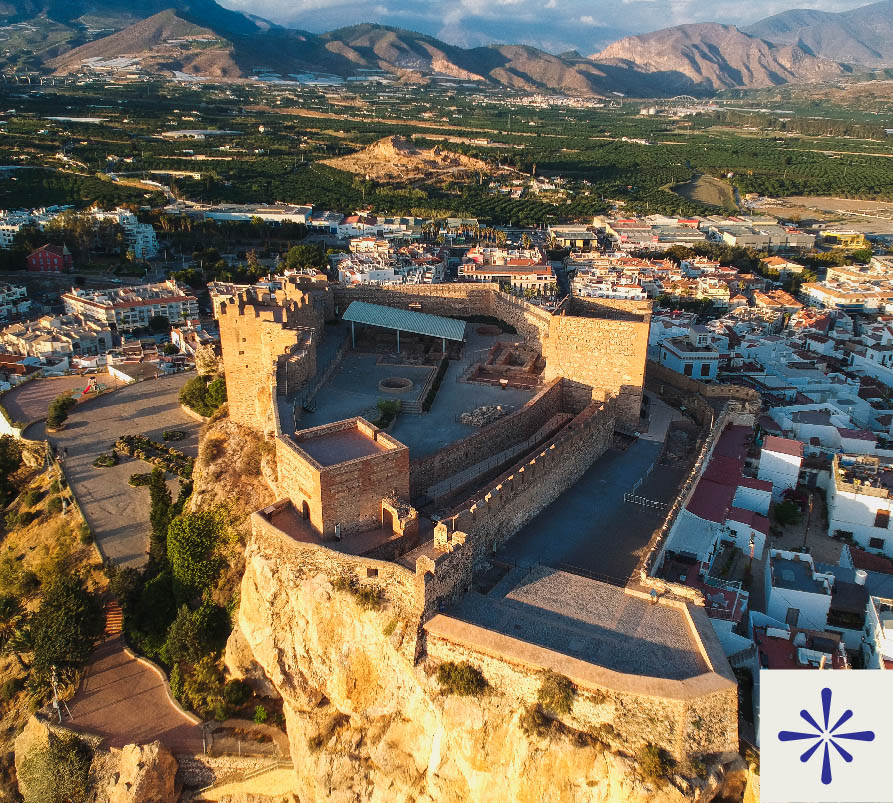
Start with the Salobrena Castle, one of the municipality's great icons, and continue through the historic quarter, with white streets, viewpoints and corners such as La Boveda, Paseo de las Flores and the Church of Nuestra Senora del Rosario.
If you would like to broaden your visit, the Route of Castles, Towers and Watchtowers links historic defensive systems across the Costa Tropical. And if you prefer to explore at your own pace, you can rely on the official audio guide with narrated itineraries.
History
that abounds
Start with the Salobrena Castle, one of the municipality's great icons, and continue through the historic quarter, with white streets, viewpoints and corners such as La Boveda, Paseo de las Flores and the Church of Nuestra Senora del Rosario.
If you would like to broaden your visit, the Route of Castles, Towers and Watchtowers links historic defensive systems across the Costa Tropical. And if you prefer to explore at your own pace, you can rely on the official audio guide with narrated itineraries.
Around 3500 BC and the first settlements
Remains found at archaeological sites such as the Cueva del Capitan (in Lobres, near Salobrena) and on the Penon of Salobrena confirm that there was already human presence in the area in Neolithic times. These early communities left flint tools, pottery, bone tools and polished stone implements behind.
Geographically, the landscape in those first millennia was very different: the Penon of Salobrena was still an island surrounded by a large bay, and what is now known as the Motril-Salobrena plain formed part of that maritime basin. Over time, sediment deposited by the Guadalfeo River and erosive processes filled in the bay and transformed the coastline.
During the Copper and Bronze Ages these processes continued: the coastline retreated, the sea withdrew, and the newly emerged land together with river deposits allowed the development of an early agricultural plain that encouraged more stable settlements.

Phoenicians, Romans and the later period (Selambina)
Although there is not an abundance of specific Phoenician records linked to Salobrena, Phoenician influence in the trade of metals and Mediterranean goods was common throughout the Costa Tropical. In later periods, under Roman rule, references already appear to Selambina, a settlement in the area that formed part of the economic system of the coast and the Guadalfeo valley.
Throughout these processes, the coastline continued its gradual transformation: the old bay was filled in, the coastal areas became more suitable for farming settlements, and human communities grew in number and organisation.
Muslim Salubanya and the Nasrid period
With the arrival of Muslim rule, the settlement took the name Salubanya (or Salobrana in its later phonetic evolution). In Islamic geographical texts from the 10th century, such as those of Al-Razi, a castle is already mentioned on the coast of the Cora of Elvira (Granada). In the 12th century, Al-Idrisi refers to Salobrena as an alqueria, a smaller nucleus within the Islamic territorial domain.
During the following centuries, especially in the 14th century, Salobrena gained greater importance and became the main medina (head town) of a rural area that included alquerias such as Velez de Benaudalla, Molvizar and Lobres.
The castle was consolidated as a defensive and administrative centre. Inside it there was also a royal palace, and at certain moments it served as a prison for nobles or monarchs.
20th century and today
During the 20th century, Salobrena underwent social, economic and urban changes with the growth of tourism, improved links with the rest of Andalusia and the rise of the service sector, all of which shaped its modern character.
Tourism began to be valued as a key activity, strengthening both its historical heritage (castle, old quarter, viewpoints) and natural heritage (beaches, surroundings). Guides, routes, signage projects and heritage recovery initiatives have been developed to bring visitors closer to its cultural and environmental richness.
Today, Salobrena presents itself as a destination that combines history, sea and nature, with an identity shaped by its millenary past and Mediterranean landscape.