Salobrena is a “white town” made up of whitewashed houses that overlook the Mediterranean Sea. The historic center is crowned by a magnificent Arab castle, surrounded by neighborhoods which were built in the Middle Ages within the old walls that fortified the town. The Brocal or Albaycín districts still conserve some amazing little spots; their narrow streets of medieval origin lead us along routes that reveal twists and turns, alleys, gates, windows, passages and vaults. As we leave those districts, the neighborhoods of Loma or La Fuente bring us closer to the valley and to the sea.
Salobreña old town is a kind of balcony, from which we can admire the blue, green and white colors of unique natural scenery.
Look out at the Mediterranean sea from the viewpoints Enrique Morente, La Frascunda, Paseo de las Flores, from the Postigo vantage point you can feast your eyes on the mountains that embrace the valley. Also El Peñon and Punta del Rio on the way on the beach
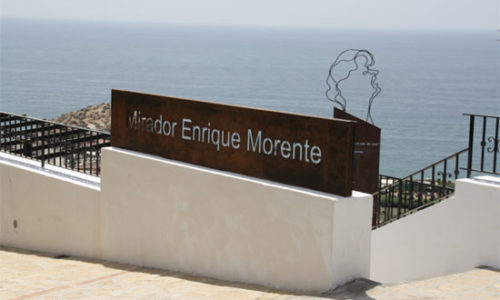
Enrique Morente
At a height of 98 metres, the vantage point offers outstanding panoramic views of the sugar cane plantations, the village of La Caleta, beaches, cliffs and the Chaparral Sierra. A memorial to one of the most important 20th century Spanish musician heads the place.
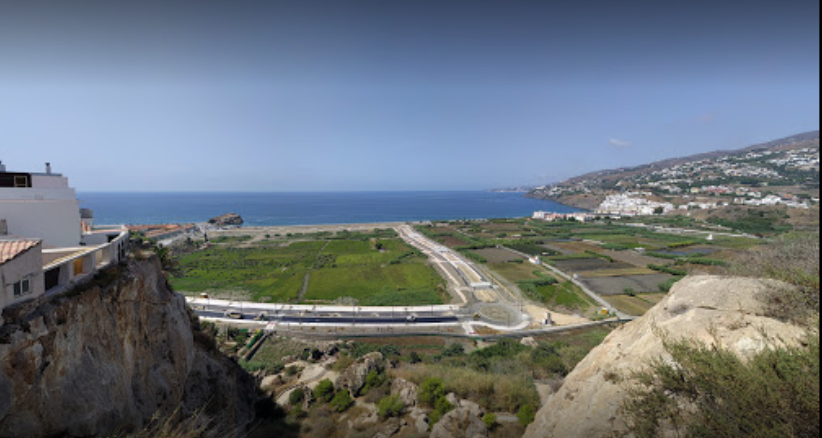
Hoya de la Frascunda

Paseo de las Flores
The first known settlers on the headland lived on this side of the hill (3000 – 2000 BC). Built in the 1970’s, the promenade enjoys a beautiful position surrounded by gardens with diverse varieties of shrubs, flowers and palm trees. Impressive views of the mountains, valley and fertile plain planted with vegetables and tropical fruit trees.

El Postigo
Its name owes its existence to a secondary gateway into the fortified town in the Middle Ages formerly known as Postigo del Mar (gateway to the sea) since it led directly to the port and beach. Nowadays, it is an observation point overlooking the northern sector of Salobreña with panoramic views of the hills and valley.

El Peñon
El Peñon is a sea rocky promontory 130 metres wide an 20 metres high above the sea level, nowadays joined to the promenade. In prehistoric times it was an island located five hundred metres from the coastline.
It boast a special historic interest. Its archaeological site has been affected to the north by the construction of a concrete platform and by rock mining during the sixties. The archaeological excavation of 1992 yielded pottery objects from the Prehistory to the Middle Age, and physical remains of a Phunic – Roman sanctuary from the 2nd – 1st centuries BC., remains of fish salting trays and several burials with a chronology subsequent to the 4th century AD.

Punta del Rio
Most of the southern slopes of the Sierra Nevda are drained by this watercourse, which flows into the Mediterranean sea. Over a long period of time it has shaped the landscape of the fertile plain. Recent geological reseach has revealed that circa 4000-3000 B.C the coastal landscape was very different compared to the present one. A wide bay was evolving whose coastaline was more than 4 km further inland than it is today which explains the former peninsular nature of the headland. The coastal bay is now the Motril-Salobrena fertile plain. At the end of the Middle Ages the headland still retained its peninsular character althoug it was surrounded by a narrow strip of beach making navigation possible between the headland and Peñón island. However, the silting up of the bay covered a substantial area and the mouth of the river was aligned with the headland. At this point we are at the few remaining marsh areas along this part of the Mediterranean coast since most have been draid and converted into arable land. We are amongst marshland densely covered with reeds and bulrushes, which serve as a refuge for a variety of fauna and numerous species of birds which, whether permanent or seasonal visitors, enjoy this protected habitat. Species typical of the area area the marsh harrier (Circus aeruginosus), kingfisher (Alcedo atthis), wagtails (Motacilla sp) wating-birds (Balbucus ibis) . This is an ideal spot for ornithologists and nature lovers.