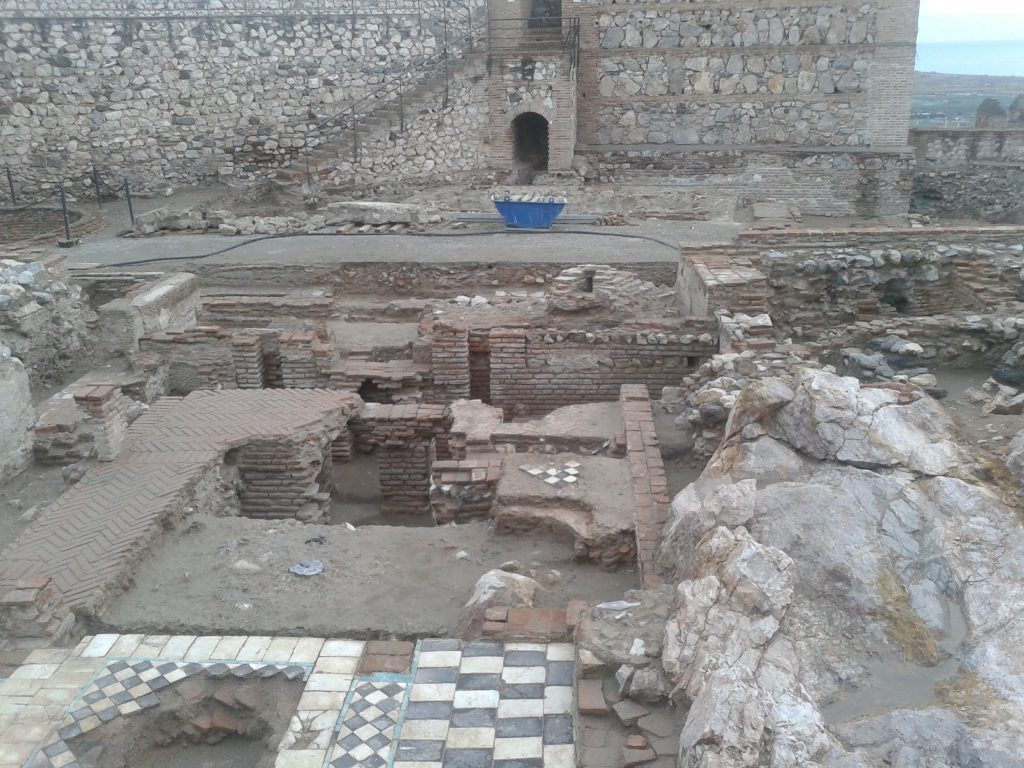

Come to Salobreña and discover its medieval castle, residence and royal prison in the Kingdom of Granada (centuries XIV-XV). Its archaeological site Nazari baths are similar in their style of building to the Alcazaba baths of the Granada Alhambra Monument, in the usual style of Muslim baths.
Three zones will be found:
Dry Zone (1-5): These are the first rooms at the entrance of the bath.
Wet Zone (6-9): Three spaces covered by brick vaults: the cool room (6), which in these baths is simply a transitional space between the dry and wet zones; the warm room (7) and the hot room (8), which has a sink (9), lined with glazed tiles, and a drain with pipes which carried the water out to the street drain (14) to the north of the bath.
Service Zone (10 and 11): This is between the hot room (8) and the street (13) which runs along the east of the baths. From this panel, which is in the aforementioned street, the Service Zone can be seen, separate from the rest of the baths. It had its own entrance (12) for maintenance staff and fuel. In the centre, remnants of the circular brick oven (10) can be seen, over which hung the water cauldron. This oven also heated the air which ran through the underfloor heating system under the hot room and exited through the four chimneys in the walls. This infrastructure formed the base of the floor of the hot room.
After the Christian conquest, the baths were transformed into a house with a patio; a brickwork herringbone floor, that can still be seen, was built over the underfloor heating system.